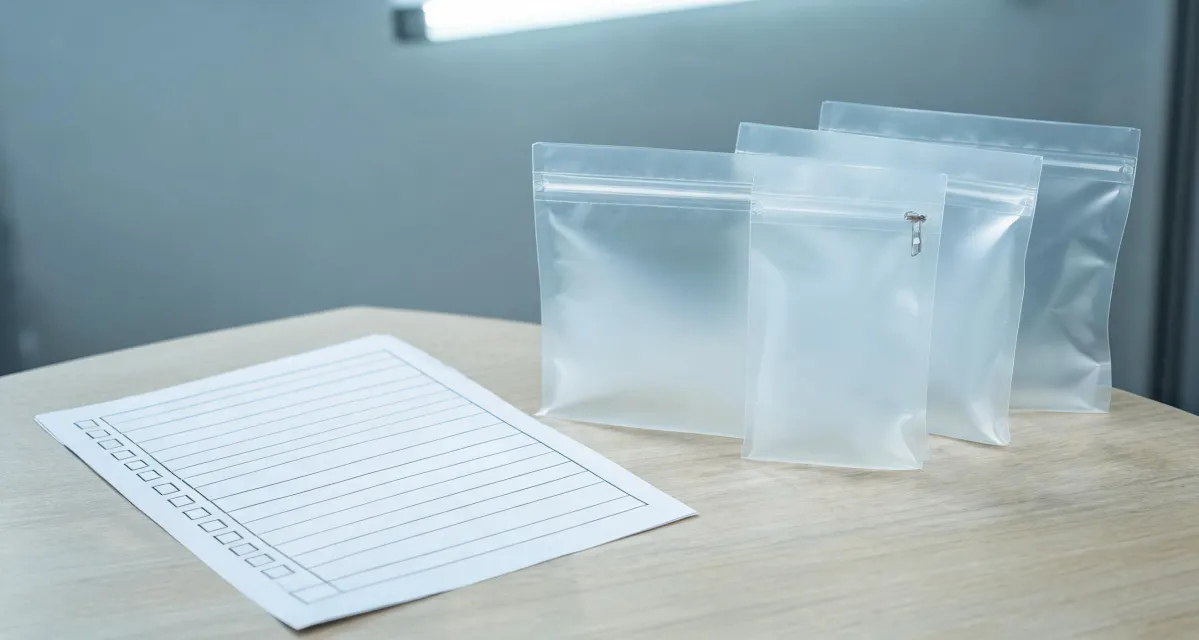
The MOQ Wall: Why Your Pouch Order Keeps Getting Rejected
When I took over packaging procurement for our 45-person snack company in 2022, I assumed the hard part would be picking a pouch style. I was wrong. The hard part was finding a supplier willing to sell me fewer than 10,000 of them.
My first three quote requests went roughly the same way. I'd describe exactly what we needed—a stand-up pouch with zipper, matte finish, maybe 500 units to test a new SKU—and the reply would come back warm and professional. Then the number: 10,000 units minimum, 15,000 if we wanted custom printing. One supplier simply stopped responding after I asked about a 1,000-unit pilot run. No rejection email. Just silence.
I figured this was just how the industry worked. Big orders only. Small brands get squeezed out and quietly told to come back when they've grown up. But after two years of managing roughly $180,000 in packaging spend across a dozen vendors, I realized the MOQ conversation is almost always misunderstood—by me, by my finance team, and honestly by most suppliers too.
The Setup Cost Is Real, But It's Not the Whole Story
Here's what nobody tells you upfront: the pouch itself is cheap. The setup is not.
For a printed stand-up pouch, the supplier has to cut print cylinders or plates—a fixed cost that doesn't change whether you order 500 units or 50,000. There's a minimum material roll width the machines can physically handle, and a minimum run length before the line is even worth starting. When a supplier quotes you a 10,000-unit MOQ, that number is often less about profit margin and more about the break-even point where the per-unit price stops looking insane.
I learned this the hard way in early 2023. We ordered 5,000 wholesale candy bags—stand-up zipper pouches, clear front, printed back—from a supplier who "made an exception" for us. The unit price was $0.42. Actually, $0.44 once freight was folded in. Our regular volume quote would have been $0.28. We paid more than 50% extra per bag, and we still waited nine weeks—or rather, closer to ten once the artwork revision cycle was factored in—because our small run got slotted behind larger clients.
So the MOQ isn't arbitrary. But here's the deeper problem: most suppliers don't explain the breakdown, so buyers assume the MOQ is negotiable. It usually isn't—not because the supplier is unfriendly, but because the math genuinely doesn't work below a certain volume. And because nobody explains that math, every small buyer spends months learning it the same painful way.
The Real Problem: Quoting Friction, Not Manufacturing Limits
This is the part I didn't understand for almost a year.
The actual bottleneck for small orders isn't the press, the material, or the sealers. It's the time it takes to quote, sample, revise artwork, and manage the job. A supplier's sales rep can spend two hours on a 500-unit inquiry and four hours on a 50,000-unit inquiry—similarly complex projects, wildly different revenue. So many suppliers quote high MOQs not because they can't run small orders, but because they don't want to spend the sales time on them.
Why does this matter? Because it means small-order-friendly suppliers aren't doing anything magic. They've just built systems—standardized quote forms, templated artwork specs, digital proofs—that let them handle a 500-unit OEM liquid stand-up pouch with spout inquiry in twenty minutes instead of two hours.
When I compared two suppliers side by side in mid-2024—one that quoted our 1,000-unit run at $0.68 and another at $0.51—the difference wasn't the machine. It was that the second supplier had a pre-built spec sheet for spout pouches and didn't need three back-and-forth emails to understand what we were asking for. Same material. Same market. Completely different response to a small buyer.
What the MOQ Problem Actually Costs You
Most buyers focus on the unit price. That's a mistake. Here's where the real money goes:
- Tied-up cash. A 10,000-unit order at $0.30 is $3,000 sitting in a warehouse not working for you. For a small brand, that's a month of runway locked in a pallet.
- Stale inventory. If you're selling candy, coffee, or anything with a shelf life, over-ordering means throwing money away when the design changes or the SKU underperforms and you're left with branded packaging nobody wants.
- Missed launch windows. The 500-unit pilot that takes eight weeks because it's low priority can wipe out an entire seasonal launch. We missed a spring promotion in 2023 over exactly this.
- Quality corners. The supplier who "makes an exception" for your small order often rushes it. I've watched valve seals fail on stand-up pouches with valve because the small run skipped a proper cure cycle—and that was a $900 mistake that got me a very direct call from our operations lead.
There's also the compliance angle, which is the one that gets small buyers in real trouble. If you're marketing a pouch as recyclable, the FTC Green Guides (16 CFR Part 260) require that the claim be substantiated for the actual market where the pouch is sold—not just the material in theory. Small runs often come from suppliers who can't provide the documentation you need, and that's a problem you inherit at a retail audit, not at the point of purchase. I'd rather pay 15% more per pouch than explain to a buyer's compliance team why my "recyclable" pouches have no paperwork behind them.
What Actually Works (Briefly)
I'm not going to pretend I solved this overnight. But three changes made small orders workable for us:
- Ask for the setup breakdown. "What's the plate cost, and what's the minimum material roll?" Suppliers who can answer in two sentences are usually worth a second call. The ones who deflect are telling you something.
- Ask about shared print runs. Some suppliers run similar designs together. If you're flexible on timing, you can ride a larger run and pay closer to volume pricing without committing to volume inventory.
- Look for suppliers who advertise small-order service, not just tolerate it. The difference shows in quote turnaround time. If they respond in 24 hours with a complete spec, they've built the system. If it takes a week and three reminders, they haven't.
The small-order-friendly suppliers exist—you just have to know how to spot one before you waste three weeks on a quote that goes silent. Look at their response speed, not their homepage.
Look, a 500-unit order is never going to price like a 50,000-unit order. That's just economics, and no amount of wishful sourcing changes it. But there's a real difference between "priced fairly for its size" and "rejected because you're too small to bother with." After five years of managing these relationships, I've learned that the vendors who treat your $400 test order seriously are usually the ones you're still buying from at $40,000. Small doesn't mean unimportant. It means potential—and a supplier who understands that is worth the slightly higher unit price, every single time.